

Heat Of Reaction Lab Report
Lab 3 - Heats of Transition, Heats of Reaction, Specific Heats, and Hess'south Law
Goal and Overview
A simple calorimeter will be made and calibrated. Information technology will be used to decide the oestrus of fusion of ice, the specific rut of metals, and the heat of several chemical reactions. These heats of reaction will be used with Hess'south law to determine some other desired estrus of reaction.
Objectives and Science Skills
-
•
Empathize, explain, and apply the concepts and uses of calorimetry. -
•
Describe heat transfer processes quantitatively and qualitatively, including those related to estrus capacity (including standard and molar), oestrus (enthalpy) of fusion, and heats (enthalpies) of chemic reactions. -
•
Employ Hess'south law using experimental data to determine an unknown oestrus (enthalpy) of reaction. -
•
Quantitatively and qualitatively compare experimental results with theoretical values. -
•
Identify and discuss factors or furnishings that may contribute to deviations betwixt theoretical and experimental results and codify optimization strategies.
Suggested Review and External Reading
-
•
See reference section; textbook information on calorimetry and thermochemistry
Background
The internal energy, E, of a system is not always a convenient holding to piece of work with when studying processes occurring at constant pressure. This would include many biological processes and chemical reactions done in lab. A more convenient property is the sum of the internal free energy and pressure-volume work (− due west sys = P Δ V
( 1 )
H ≡ E + pV ( definition of enthalpy , H )
Enthalpy is simply a corrected energy that reflects the modify in energy of the organisation while it is allowed to aggrandize or contract confronting a abiding pressure. For whatsoever process occurring at constant pressure, the alter in the enthalpy, Δ H, is the estrus absorbed or released past the organisation.
( ii )
Δ H ≡ H terminal − H initial = q p = heat captivated by organisation (constant p )
A organization can exist thought to "contain" enthalpy, just as it does energy. Some contributions to the enthalpy of a system include the following.
-
1
Thermal Enthalpy. The college the system'southward temperature, the greater its enthalpy. This makes sense because it takes heat to enhance the temperature of an object. -
2
Phase Enthalpy. The liquid phase has higher enthalpy than the solid, and the vapor stage has higher enthalpy than the liquid. This also makes sense because it takes heat to melt a solid or to vaporize a liquid. -
3
Chemic Enthalpy. Chemical bonds store energy. When a chemic reaction occurs, the chemic enthalpy of the reactants changes when they course products.-
i
If the reaction is exothermic, the chemical enthalpy decreases as the reaction proceeds. -
ii
If the reaction is endothermic, the chemical enthalpy increases as the reaction proceeds.
-
Enthalpy changes are determined by measuring the corporeality of rut transferred during a physical or chemical process. The quantitative treatment of the above 3 kinds of enthalpy, are all based on use of Eq. 2 Δ H ≡ H final − H initial = q p = heat captivated past arrangement (constant p )
Temperature
When at that place is a change in the temperature of the system, Δ H is proportional to the temperature modify, T terminal − T initial = Δ T .
( iii )
Δ H ≡ H final − H initial = C ( T last − T initial) = C Δ T ( temperature alter )
Because it is the difference in temperature that determines Δ H, either °C or Thousand temperatures will give the identical result. Δ H of the system is also proportional to the amount of fabric. The rut energy required to heighten the temperature of one gram of material is its specific heat capacity, c. If amount is expressed in moles, then the tooth oestrus capacity C is used.
( 4a )
C full ≡ m c per gram = n C per mole
Therefore, the system's Δ H is the product of the amount, the estrus capacity (specific or tooth), and the alter in temperature.
( 4b )
Δ H = C total Δ T = m c per gram Δ T = due north C per mole Δ T
If Δ T of the organisation is positive, temperature increases, the arrangement absorbs heat, and q (or Δ H) is positive. If Δ T of the system is negative, temperature decreases, the arrangement gives off oestrus to its surroundings, and q (or Δ H) is negative. Unit assay will help you determine how to use the above equation. Δ H (or q) must have an free energy unit. Units for heat capacity are:
c : energy per gram per degree due east.thousand., J/°C · k C : free energy per mole per degree e.g., J/°C · mol C general energy per degree e.1000., J/°C.
Phase
At a phase modify, the temperature of the system is constant until the transition is complete. The amount of estrus required is proportional to the amount or textile nowadays, and the Δ H of the phase transition. The heat energy can also be expressed in terms of moles (heat per mole).
( 5 )
Δ H = m Δ h per gram = n Δ H per mole ( stage modify )
The value of Δ H is positive (heat is captivated) for melting, vaporization, and sublimation processes. It is negative for the reverse (freezing, condensation, and degradation). In this experiment, nosotros volition use 'Δ h' to represent the enthalpy change per gram.
Chemical Reaction
The chemical reactions studied here occur at a particular pressure and temperature. Each reaction has an associated enthalpy alter that is chosen the rut or enthalpy of reaction that depends on the way the reaction is counterbalanced. For example, Δ H reaction 2 H2O → 2 H2 + O2 H2O → H2 + 1/2 O2, and Δ H reaction Δ H = m Δ h per gram = n Δ H per mole ( phase change )
( 6 )
Δ H = m Δ h per gram = n Δ H per mole ( reaction )
Calorimeter
A calorimeter is an insulated vessel in which concrete or chemic processes are performed while neglecting heat flow between the vessel and its surroundings. A process in which the heat period, q, equals zero is chosen adiabatic. To a first approximation, the heat flow (+ or –) between calorimeter and the surroundings is zero, so Δ H (or q) for the calorimeter and its contents will be zippo.
( 7 )
Δ H calorimeter and contents = q total = 0 (master equation for calorimeters)
Example one: Calorimeter Calibration
A mass m 1 of water at temperature T 1 is placed in the calorimeter. Mass k ii of water at T ii is added. The calorimeter itself has a small heat capacity that must be accounted for in order to have reasonable precision. The calorimeter always contributes a term to the full enthalpy change.
( 8 )
Δ H calorimeter = C calorimeter( T final − T initial contents)
Initially, the calorimeter is at the aforementioned temperature, T 1, equally the water it contains. When rut menstruum stops, all of the h2o and the calorimeter have reached the same temperature T final (at thermal equilibrium). In this example, in that location are 3 quantities contributing to the total enthalpy change (which is assumed to be null): the ii amounts of water and the calorimeter.
( 9b )
Δ H one + Δ H calorimeter + Δ H ii = 0
( 9c )
thousand 1 c water( T terminal − T 1) + C calorimeter( T last − T 1) + yard ii c water( T last − T 2) = 0
Note that the initial temperatures are not the aforementioned, but everything shares a common final temperature. Eq. 5 Δ H = m Δ h per gram = n Δ H per mole ( phase change ) Δ H total = 0 Δ H 1 + Δ H calorimeter + Δ H ii = 0 thou 1 c water( T final − T 1) + C calorimeter( T final − T 1) + m 2 c water( T final − T ii) = 0
Instance 2: Specific Heat Decision
Suppose a mass m one of water with specific rut c one is placed in the calorimeter at T ane. Then a mass m 2 of another substance, such every bit a metal, at T 2 and with specific heat c 2 is added. The equation is similar to that of Eqns 9a Δ H full = 0 Δ H 1 + Δ H calorimeter + Δ H 2 = 0 thou 1 c water( T last − T 1) + C calorimeter( T final − T 1) + m 2 c water( T terminal − T ii) = 0
( 10b )
Δ H 1 + Δ H calorimeter + Δ H ii = 0
( 10c )
k one c water( T concluding − T 1) + C calorimeter( T final − T one) + thou ii c 2( T final − T 2) = 0
Note once again that the initial temperatures are not the aforementioned, but everything shares a common final temperature. Eq. 5 Δ H = g Δ h per gram = north Δ H per mole ( phase modify )
( 11 )
C per mole = MM c per gram = abiding for all metals = 3R MM = tooth mass of the metal; R = gas constant (8.314 J/k · mol).
Using precise specific heat measurements, Berzelius used Eq. eleven to find many molar masses. In 1830, he published an extremely accurate table of tooth masses that gave great impetus to the development of diminutive/molecular theory.
Example 3: Enthalpy of Phase Modify Decision
Suppose a mass m i of water is placed in the calorimeter at T 1, and mass m two of water ice at 0°C is added. As the apparatus reaches thermal equilibrium, several things occur. First, the ice melts, pulling its heat of fusion out of the thermal energy of the water and calorimeter, thus lowering their temperatures. Second, when the water ice has melted, the resulting liquid is still at 0°C, then that water has to be further heated until it, the water it is cooling, and the calorimeter achieve the same concluding temperature.
( 12b )
Δ H cool water + Δ H absurd calorimeter + Δ H melt ice + Δ H warm melted ice = 0
( 12c )
k one c water( T last − T 1) + C calorimeter( T concluding − T 1) + m water ice Δ h fusion, per g + m water ice C water( T terminal − 0°C) = 0
Note that the heat of fusion of ice is expressed in units of energy per mass (J/k or kJ/g); if the amount of ice were in moles, the heat of fusion would take units of energy per mole (J/mol or kJ/mol).
Instance 4: Reaction Enthalpy Determinations
Suppose mass yard 1 of a water-based solution is placed in the calorimeter at T i. To that mass m 2 of a substance of tooth mass MM 2 is added and information technology reacts with the solution. If substance 2 is the limiting reactant, and so all of information technology volition react. The enthalpy change volition depend on the heat of reaction and on the number of moles of substance 2 added, n 2 = thou ii/MM ii. In this case, there are three contributions to the full enthalpy modify of zilch. They are due to the temperature change of the water solution and calorimeter, plus the enthalpy change due to the chemical reaction. For reactions in solution, the rut capacities of the reactants and products are approximated as zero because only the h2o and the calorimeter have significant heat chapters. In the last pace it is causeless that the chemical reaction is written in such a way that the stoichiometric coefficient on the reactant, substance 2, is 1.
( 13b )
Δ H 1 + Δ H calorimeter + Δ H chemical reaction = 0
( 13c )
m one c water( T final − T 1) + C calorimeter( T final − T 1) + Δ H reaction = 0
The final term has been written so that ΔHreaction has a unit of energy per mole (J/mol or kJ/mol). In 1840, Hess stated that the evolution of rut past chemical reactions is the same, regardless of whether the reaction takes identify in one footstep or in more than than one. Heats of reaction are changes in the holding, H, of a system. When a system changes from country i to state 2, H will have to change by the amount H 2 – H 1, regardless of the number or kind of steps involved in the procedure. Hess' Law permits the heats of experimentally hard reactions to be deduced from measurements of other more than convenient reactions.
Experimental Notes
In that location are 2 possibilities for your calorimeter setup, but both require the aforementioned procedure.
-
a
Coffee Cup Calorimeter Setup — the calorimeter consists of 2 nested Styrofoam cups with a chapeau. -
b
Styrofoam Calorimeter Setup — the calorimeter consists of a Styrofoam base and lid.
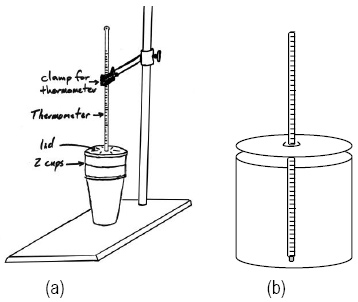
Figure ane
A thermometer is placed through a hole in the chapeau to measure the temperature of the liquid. If you lot employ set-up (a), apply a slotted safety stopper to protect the thermometer in the clamp. Both setups are constant pressure level calorimeters.
Please do not throw your calorimeter away. Render it make clean to the reagent bench. this applies to both (a) and (b).
Measurements
The two key measurements for all calorimetry experiments are masses and temperature changes. Make sure you lot take all of the data you demand to consummate the lab. Yous may need these conversion factors: m J = one kJ, and four.184 J = ane cal.
Note: Make sure you record/obtain all information required to complete the calculations. This includes the heat capacity of all calorimeters used to gather your data.
Process
Office one: Heat Capacity of the Calorimeter
This is the experiment discussed in Example ane. This result is of import because you will use it in the other experiments you perform with this calorimeter.
1
Record the mass of your calorimeter to 0.01 thou.
two
Add together near 100 mL of room temperature water.
3
Record the mass of the calorimeter and water; determine the mass of this h2o by divergence to 0.01 g.
four
To equilibrate the beaker used to transfer the warm water to the calorimeter, take a small-scale beaker to one of the warm water baths (approximately 35°C) in the lab. Submerge the beaker in the warm water bath for a couple minutes.
5
Record the temperature (to the nearest 0.1°C) of the water in both the warm water bath and in your calorimeter just before you add the warm water to the room temperature h2o.
6
Brand certain your calorimeter is at least 4 anxiety abroad from whatsoever hot plate, and try to minimize drafts.
seven
Using the equilibrated beaker, scoop upward near 100 mL of warm water from the h2o bath and pour information technology into your calorimeter.
8
Chop-chop put on the chapeau and insert the thermometer.
9
Stir the water and read the final temperature reached past the mixture to 0.1°C.
10
Remove the thermometer and record the final mass (so you can make up one's mind the mass of warm h2o added) to 0.01 grand.
11
Redo the calibration at least ane time to verify the calorimeter's estrus capacity.
12
Calculate the heat capacity of your calorimeter, using Eqns. 9a Δ H total = 0 Δ H one + Δ H calorimeter + Δ H two = 0 m 1 c water( T final − T 1) + C calorimeter( T final − T 1) + m 2 c h2o( T final − T 2) = 0
( 9d )
Δ H 1 + Δ H calorimeter + Δ H 2 = m one c water( T terminal − T 1) + C calorimeter( T final − T 1) + g ii c 2( T concluding − T 2) = 0
- Finding the heat capacity of your calorimeter this style is very sensitive to modest errors. The "correct" value is probably between v and 150 J/°C. If you get a negative value or a very big value, re-do the calculation or the experiment. Utilize a new set of cups if yous get a high calorimeter abiding (heat loss).
Function 2: Estrus of Fusion of Ice
This is the experiment discussed in Case iii.
1
Tape the mass of your empty, dry calorimeter to 0.01 g.
2
Add virtually 100 mL of room temperature water.
three
Tape the mass of the calorimeter and water; determine the mass of this water past difference to 0.01 g.
4
Identify your calorimeter on a ring stand up and carefully clamp your thermometer (inserted through a slotted safety stopper) to the stand up so that the thermometer near reaches the bottom of the calorimeter.
5
Measure the temperature of your h2o to 0.one°C.
half-dozen
Add near 25 g of ice. Solid ice is preferred over slushy ice. Why is this?
vii
Swirl the calorimeter to heighten mixing and picket as the temperature falls.
eight
Tape the everyman temperature reached to 0.i°C.
9
Carefully remove the thermometer and record the final mass to 0.01 g (so y'all tin determine the mass of water ice added).
x
Summate the estrus of fusion of ice in J/g, using Eqns. 12a Δ H total = 0 Δ H cool h2o + Δ H cool calorimeter + Δ H melt ice + Δ H warm melted ice = 0
( 12d )
Δ H absurd water + Δ H cool calorimeter + Δ H melt ice + Δ H warmup melted water ice = m 1 c water( T last − T i) + C calorimeter( T concluding − T 1) + grand water ice Δ h fusion, per chiliad + k ice c water( T last − 0°C) = 0
11
Some liquid water probably went into your calorimeter along with the ice. How would that affect your result?
12
Convert your answer into units of kJ/mol. Report your reply to three meaning figures.
xiii
Summate the percent error in your experimental event relative to the literature value of 6.01 kJ/mol.
Part 3: Specific Rut of a Metal
Begin the temperature equilibration of the metal at the beginning of the lab. This is the experiment given in Example 2.
1
You will study either copper or aluminum. Record which metal yous choose.
2
Have 20–30 g of the metal and tape the mass to 0.01 yard.
3
Carefully place the metal in a large test tube suspended in a boiling water bath made in a 400 mL beaker.
four
Leave the test tube there for at least xxx minutes to equilibrate the metal to the temperature of the bathroom. Do this at the beginning of the experiment so the metal heats while you are doing other things. Keep the calorimeter away from the hot plates.
Caution:
Steam burns are especially severe, as the steam condenses to liquid on your skin and gives up its heat of vaporization to the tissues. So whenever you piece of work effectually steam, pay attending.
5
Tape the mass of the clean, dry out calorimeter to 0.01 g.
6
Put virtually 100 mL of water into information technology and record the mass to 0.01g.
7
Tape the temperature of the water and calorimeter to 0.i°C.
8
Carefully record the temperature of the "boiling" water bath with a 110°C thermometer (to 0.v°C).
9
Carefully slide the hot metal from the exam tube into the calorimeter. Practise not hit the thermometer or add together humid h2o from the bath. Do not allow the thermometer touch the metal.
10
Swirl the calorimeter gently and constantly.
eleven
Record the maximum temperature to 0.i°C.
12
Return the clean, dry, absurd metallic to the reagent demote.
13
Calculate the specific heat of your metallic to iii significant figures, using Eqns. 10a Δ H full = 0 Δ H i + Δ H calorimeter + Δ H 2 = 0 m 1 c water( T terminal − T 1) + C calorimeter( T concluding − T ane) + 1000 2 c 2( T final − T 2) = 0
( 10d )
Δ H 1 + Δ H calorimeter + Δ H 2 = chiliad one c water( T last − T 1) + C calorimeter( T final − T 1) + m 2 c two( T terminal − T ii) = 0
xiv
Using the molar mass and experimental specific heat of your metal, calculate the molar oestrus capacity, C, and compare it to the Dulong and Petit value of 3R (R = 8.314 J/Yard · mol).
Part iv: Estrus of a Chemic Reaction
This experiment is discussed in Example iv. You lot volition measure the heats of 2 reactions: a Mg + 2 HCl → MgClii + Hii( thou ) Δ H a = measured b MgO + two HCl → MgCl2 + HtwoO( l ) Δ H b = measured c Hii( g ) + 1/2 O2( g ) → H2O( l ) Δ H c = −285.8 kJ d Mg + ane/2 O2 → MgO Δ H d = ???
You too need a Δ H value for reaction c, which is from the literature.
Using these Δ H values and Hess'due south Law, you tin determine the Δ H for magnesium combustion (or germination), where magnesium metallic is burned in oxygen.
1
Record the mass of the clean, dry calorimeter to 0.01 1000.
2
Put 50 mL of distilled water into the calorimeter.
3
Add together 25 mL of approximately 2 M HCl.
4
Record the mass of this water and acrid combination to 0.01 one thousand.
5
Have virtually 0.10–0.15 chiliad of magnesium ribbon and record its mass to 0.01 g.
half-dozen
Accept the initial temperature of the acidic water in the calorimeter to 0.ane°C.
vii
Add the metal, stir constantly, and record the maximum temperature reached to 0.one°C. The reaction takes a while, so exist patient.
8
Echo this procedure substituting about 0.30g of magnesium oxide for the magnesium ribbon.
The goal is to make up one's mind the estrus of reaction for the combustion of magnesium to course the oxide. Mg + 1/2 O2 → MgO Δ H rxn = ?
Target:
9
Using Eqns. 13a Δ H full = 0 Δ H i + Δ H calorimeter + Δ H chemical reaction = 0 m 1 c water( T final − T 1) + C calorimeter( T final − T i) + Δ H reaction = 0 Δ H a and Δ H b
( 13d )
Δ H 1 + Δ H calorimeter + Δ H chemical reaction = m 1 c h2o( T last − T 1) + C calorimeter( T last − T i) + Δ H reaction = 0
10
Using Δ H a, Δ H b, and Δ H c , employ Hess' Police force to summate the rut of reaction for the magnesium combustion reaction (to three significant figures).
Annotation: Whenever you lot reverse a reaction, the sign of Δ H changes. That is because enthalpy is a country role; Δ H of state 2 to country 1 is equal in magnitude merely opposite in sign of Δ H from country 1 to state two.
11
Calculate the percent error in experimental value for the target reaction (literature value for the heat of germination of MgO(s) –601 kJ) to three significant figures.
12
Calculate the percent error in your experimental Δ H a and Δ H b values (literature values are –462 kJ/mol for (a) and –146 kJ/mol for (b)) to three pregnant figures.
Waste material Disposal: As per TA instruction; you will lose points if you do not dispose of waste properly.
Reporting Results
Complete your lab summary or write a report (as instructed).
Abstract
Results (final results are reported to three significant figures)
- Calorimeter heat capacity
- Heat of fusion of water ice
- Specific heats of metals
- Heats of reaction from office 4 and for combustion of Mg.
Sample Calculations
- Calorimeter oestrus capacity (function 1)
- Heat of fusion of ice (part two)
- Specific heat of metals (part 3)
- Heat of reaction for one of office 4 reactions (part 4)
- Heat of magnesium combustion using Hess' Law (part four)
Discussion
- What you institute out and how for each part
- How proficient was your data (comparison to expected values, etc.)
- Ideas to improve the accuracy in any or all of the procedures utilized in this experiment?
- What conclusions tin can yous draw?
Review

Heat Of Reaction Lab Report,
Source: https://www.webassign.net/labsgraceperiod/ucscgencheml1/lab_3/manual.html
Posted by: outlawwifear91.blogspot.com
0 Response to "Heat Of Reaction Lab Report"
Post a Comment